Learning About Addiction Treatment, Part 2

In this post, I continue the description of what I learnt about addiction treatment by talking with practitioners at a local treatment agency in Swansea, West Glamorgan Council on Alcohol and Drug Abuse (WGCADA). You can read my previous post here.

The Primary Treatment programme at WGCADA used key principles of AA and the 12-Step Minnesota model. It was based on the disease concept and on the belief that the illness of addiction is physical, mental and spiritual. A holistic approach was used to help the person recover from addiction, and clients underwent considerable self-examination during the treatment process. Clients could not be drinking or using illegal drugs when they entered the Primary Treatment programme.

Read More ➔

Learning About Addiction Treatment, Part 1

In my last blog posts, I described how after nearly 25 years as a neuroscientist I decided to close my research laboratory in the Department of Psychology at Swansea University at the start of the new millennium. I wanted to learn more about the nature of addiction and how people overcame their substance use problem.

I spent a good deal of time at a treatment agency in Swansea, talking with both practitioners and people who attended the agency for help with their problem. In addition, I was travelling around Wales visiting treatment agencies, in my capacity as lead on a two-year national evaluation of projects supported by the Drug and Alcohol Treatment Fund. This fund was created by the National Assembly for Wales, or Senedd Cymru (Welsh Parliament) as it is now known.

Read More ➔

Brain Chemicals to Human Connection, Part 2

In an earlier blog, I described how I spent nearly 25 years working as a neuroscientist in academia. In 2000, I made the decision to close my neuroscience laboratory and focus on working in the addiction field with humans (rather than laboratory rats). I set up an initiative called WIRED (later to become Wired In) and a charity Wired International Ltd. I continued by job as a Professor of Psychology, but when I wasn’t teaching I was engaged in a range of activities in the addiction field. The following section is taken from the last chapter of my new eBook Our Recovery Stories: Journeys from Drug and Alcohol Addiction.

Read More ➔

It’s Not Just About the Drug, Part 3

I continue my series of blog posts focused on drug, set (the person) and setting (the social context) [Part 1 is here]. Drug, set and setting is not only of relevance to addiction, but also to overcoming addiction.

The path into and out of addiction
The ‘person’ and ‘social context’ factors influence early substance use and the likelihood that a person will develop problematic use and addiction. In general, individuals are less likely to develop substance use problems if they have fewer complicating life problems, more resources (social, personal, educational, economic), and opportunities for alternative sources of reward.

One explanation is that these individuals develop a weaker attachment to the substance in that for them substance use does not serve as many emotional, psychological or social needs.

Read More ➔

Welcome Home, Adam

As I write this, my good friend Adam Brookes, he of Adam’s Story, is just two hours away from arriving back in Australia. I will post this blog after I hear that he has landed in Darwin, en route for a two-week stay in Howard Springs Quarantine Facility. Then he’s heading back home to Dapto in New South Wales.

For those of us who know Adam, his arrival will be the most wonderful news. In fact, I was absolutely over-the-moon with joy when I heard he had passed through into the departure lounge at Heathrow Airport yesterday afternoon my time here in Perth. Why, you might ask?

Read More ➔

Some Magical Words About Recovery: Tim

I’d like you to ‘meet’ Tim, a medical doctor who found recovery from addiction. He is one of the Storytellers in my new book Our Recovery Stories: Journeys from Drug and Alcohol Addiction. In the seven-year update to his original Story, ‘Doctor in Recovery’, Tim wrote some magical words about recovery that I include below. But first, a brief summary of Tim’s original story, using some of his sentences.

‘Growing up in an alcoholic home is a challenge for any child and I was no different. I found school a haven from the unpredictability of my home life. I started to drink to deal with the stresses of work after medical school. Over time, my drinking became worse and worse.’

One morning, as I took the cornflakes and a bottle of whiskey off a shelf together, I thought, ‘This isn’t quite right.’ My first experience of treatment was medical-based—it had prescriptions, but lacked hope! I experienced terrible anxiety and cravings. After relapsing, I made the ‘discovery’ that opiates abolish craving for alcohol… and developed an opiate addiction as well.

Read More ➔

Michael’s 43rd (Sober) Anniversary

My good friend Michael (Mike) Scott last had a drink 43 years (15,695 days) ago today. Tonight, we will celebrate his 43rd Sober Birthday. This morning, I’m going to celebrate his achievement with a blog post focused on some of Mike’s experiences and reflections.

Mike first contacted me about our Daily Dose website back in 2002. He loved our drug and alcohol news portal that I had launched with Ash Whitney early in 2001. Mike met Ash for the first time (on Skype) a few weeks ago and the pair were mutually pleased to have their first chat.

I gave Mike a big shock when I called him one day back in 2009 and suggested that we have lunch together. He replied, ‘How can we do that? You live on the opposite side of the world.’ I told him that I had moved to Perth on Christmas Day 2008.

Read More ➔

60th Birthday Greeting to a Remarkable Man: Kevan Martin

Kevan Martin is sixty today. Coincidentally, the day that I launch my eBook Our Recovery Stories: Journeys from Drug and Alcohol Addiction. Kevan’s Story, ‘He’s a Loser and Will Never Be Any Good‘ is one of 15 stories in the book. It’s an impressive and moving story about the overcoming of adversity… and a commitment to helping other people overcome addiction.
Kevan is one of the most remarkable people I have met. Actually, I better change that. I’ve never met Kevan in person, only on Skype. And yet I feel as if I have known Kevan for years. It feels as if we are best mates.

I want to celebrate Kevan’s birthday by relating a summary of his original Story written in 2013, just to highlight what he has come through.

Read More ➔

‘Our Recovery Stories’ eBook Available Tomorrow

‘Learn from the True Experts’

Recovery from addiction comes from the person with the problem. They do the work in overcoming their substance use and related problems, getting well, and getting their life (back) on track. Recovery is a process of self-healing. Practitioners, peer supporters and others may facilitate recovery, but they do so by catalysing and supporting natural processes of recovery in the individual. 

Our Recovery Stories: Journeys from Drug and Alcohol Addiction comes out tomorrow as a self-published eBook (170,000 words). It can be purchased from Apple, Amazon or Kobo. It is available via Apple, Amazon or Kobo (price: £4.99, A$8.99, US$6.99, €5.99). Please note, that you must purchase and download the book from the supplier’s store in your country or region. Just search for the book using the words of the main title. The Amazon and Kobo links above are for the UK stores. There is no link for Apple, as their system works differently through the Apple Books app. Further information about purchasing can be found at the bottom of this page.

Read More ➔

My Friend Natalie

I first met Natalie in my early days of working in the addiction field in the community. I still remember clearly her telling me that when she was using heroin, she did not know how to stop. She could find no information about how to stop using heroin. She knew no one who had stopped using.

Fortunately, Natalie accessed a high-quality treatment agency (WGCADA) and she found recovery. When we met, she told me that there needed to be stories of people who had found recovery available so that people with a drug and/or alcohol problem could read and learn from them.  I asked her if we could write her Story. She agreed.

Read More ➔

Learning from the Experts

When I was a teenager, I competed in chess competitions around the UK, including the British Under-18 championship on two occasions. I was my county junior champion. To be competitive, I had to study chess theory and practice. I learnt from those people who were champions at what they did, including world champions. Not by being in the same room as them—although I did play Anatoly Karpov, who was later to be world champion, in a simultaneous exhibition—but by their games and introspections. I learnt from the experts.

You would have thought that people working in the addiction field would also be learning from the experts—the people who are in recovery, or are recovering, from a serious substance use problem. Many do. But… you’d be surprised to know that this goes on far too little, at least from my experience.

Read More ➔

‘Our Recovery Stories’ Update

I just wanted to let you know that the eBook Our Recovery Stories: Journeys from Drug and Alcohol Addiction will be available from 9th April 2021. It will be available via Apple, Amazon or Kobo (price: £4.99, A$8.99, US$6.99, €5.99). I will provide links and any other relevant information shortly.

I have chosen this date for release, as it is my youngest son Sam’s birthday and is a day before Michael Scott’s, of Michael’s Story, 43rd Sober Anniversary. And I then learn that the 9th April is the 60th birthday of Kevan Martin, of Kevan’s Story. Couldn’t have chosen a better date.

Please note that the book will have to be read on a phone, tablet or a computer. I hope to publish a hard copy version at a later date. Here is what I have said in the publicity material:

Read More ➔

‘What is Recovery?: David Best

Here is a blog I wrote about David Best in May 2013. At that time, he had done a huge amount for the addiction recovery field and for the Recovery Movements in the UK and Australia, in terms of his research, writings, advocacy and a wide range of other recovery-based activities. Where he gets his energy from, I have no idea?

I thought it was worth showing what David thinks about the question, ‘What is Recovery’. I’ve followed his arguments and included quotes from his excellent book, Addiction Recovery: A Movement for Social Change and Personal Growth in the UK.

Read More ➔

Why the Need for Recovery-based Care?

A resonating message I have picked from many people affected by serious substance use problems over the years is their desperate need for hope (that they can recover) and understanding (of how to recover). Here is a blog I originally posted in May 2013.

There is a dearth of readily accessible information on how to achieve recovery, information that is also relevant to the day-to-day struggles and obstacles that people face in trying to overcome addiction and related problems. Many people do not know anyone who has recovered from addiction. Many find the treatment system to be disempowering and lacking in hope.

Read More ➔

‘What is Recovery?’: Julie Repper & Rachel Perkins

In my blogs, I will explore the nature of recovery and will sometimes focus on the ideas of someone else (or a group of people). I’ve previously looked at how David Best has talked about ‘What is Recovery?’ David described key principles underlying addiction recovery.

In this blog, first posted on this website in June 2103, I am going to look at what Julie Repper and Rachel Perkins have to say about ‘What is Recovery?, as described in their excellent book Social Inclusion and Recovery: A Model for Mental Health Practice. They include a number of quotes about recovery, some of which I will use here.

Read More ➔

‘A Day With Dave’ by Annalie Clark

I posted this originally in July 2013, a day before lovely daughter Annalie headed back to the UK tomorrow, having spent a year here in Perth working as a doctor (along with her boyfriend Max) in the emergency department of  a local hospital. Over seven years later, Annalie is a psychiatrist working in the UK.

Here’s an article that Annalie wrote in the summer of 2005, when she had just finished her first year of medical training at the University of Edinburgh. It appeared in a June edition of Drink and Drugs News. The article is about Dave Watkins who used to be a top-class support worker at a treatment centre in Swansea.

Read More ➔

‘Community Recovery’: Bill White

An excellent paper by Arthur Evans, Roland Lamb and Bill White, highlighted in a blog by the latter, which I originally posted in December 2013.

‘In the Red Road to Wellbriety, the individual, family and community are not separate; they are one.  To injure one is to injure all; to heal one is to heal all.’ The Red Road to Wellbriety, 2002

As a field, we have long known that the effects of personal addiction ripple through families, social networks and organizations.  But might whole communities and whole cultures be so wounded by prolonged alcohol and other drug problems that they are themselves in need of a sustained recovery process?  This suggestion is the premise of a new paper co-authored by Dr. Arthur Evans, Jr., Roland Lamb and myself just published in Alcoholism Treatment Quarterly.

Read More ➔

Climbing Out of Addiction and Depression: Margo Talbot at TEDxCanmore

Great talk and pics and one hell of a recovery! I first posted this film in July 2014.

‘Current research suggests that addiction and depression are symptoms of emotional distress, not causes of it, forging the link between childhood trauma and mental illness. Margo Talbot’s journey supports these studies.

Diagnosed Bi Polar at age twenty-two, Margo spent the next fifteen years in suicidal depression before discovering the healing power of presence as the antidote to emotional trauma. Being present to our thoughts and emotions, not running the other way or masking them. Where best to practice the art of presence than the frozen world of ice climbing…

Read More ➔

Eleanor Longden: The Voices in my Head

Brilliant and very moving TED talk from Eleanor Longden.

‘To all appearances, Eleanor Longden was just like every other student, heading to college full of promise and without a care in the world. That was until the voices in her head started talking. Initially innocuous, these internal narrators became increasingly antagonistic and dictatorial, turning her life into a living nightmare.

Diagnosed with schizophrenia, hospitalized, drugged, Longden was discarded by a system that didn’t know how to help her.

Longden tells the moving tale of her years-long journey back to mental health, and makes the case that it was through learning to listen to her voices that she was able to survive.’ TED2013

Relationships, Connection and Healing from Trauma

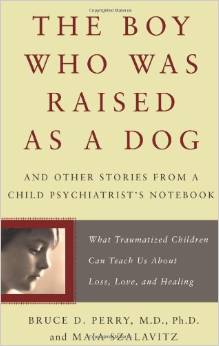
UnknownI’m reading an excellent book at the moment, which I can strongly recommend to you. If you’re working in the trauma field, then The Boy Who Was Raised as a Dog: And other Stories From a Child Psychiatrists Notebook by Bruce Perry and Maia Szalavitz is an essential read.

The book really gives you a feel for how our understanding of childhood trauma and its healing has moved along over the years. Bruce Perry is a real leader in this field and I feel blessed to have learnt of both Bruce’s and Bessel van der Kolk’s work in the past year. Thank you Judy and Carlie Atkinson.

Here’s a little section from the book:

‘Trauma and our responses to it cannot be understood outside the context of human relationships… The most traumatic aspects of all disasters involve the shattering of human connections. And this is especially true for children…’

‘Because humans are inescapably social beings, the worst catastrophes that can befall us inevitably involve relational loss.

Read More ➔