
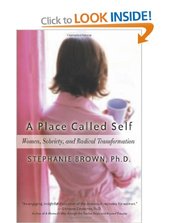
What Happens to Women in Recovery: Stephanie Brown

In the Resources section of the website, I have a series of my posts under the title Stephanie Brown on Recovery. These posts are based on Stephanie Brown’s wonderful 2004 book A Place Called Self: Women, Sobriety, and Radical Transformation. In her book, Stephanie talks about what happens to women in recovery, how they think, how they feel, their problems, the good things, etc. (The book is relevant to men as well!) Here is the main part of the first of my posts, entitled ‘What is Recovery’, according to Stephanie Brown (Part 1).

“‘Recovery has held so many surprises for me. Some good. Some bad. I didn’t know I could hurt so much. But I also didn’t know I could love so much and be so loved. I had no idea that recovery was also learning how to be in intimate relationships, learning how to have close, wonderful friends. Then there’s my marriage. My husband and I have developed a rich life together. And get this – I really like myself now. Learning about who I am and accepting me, that’s been the hardest part of recovery – and the best. I wouldn’t trade this path for anything in the world.’ Anne, Recoveree

Read More ➔

Factors Facilitating Recovery: Mutual Support

I continue with my series of blog posts relating to the factors that facilitate recovery from addiction, which I have detailed in the second last chapter of my eBook Our Recovery Stories: Journeys from Drug and Alcohol AddictionThese factors are also relevant to recovery from mental health problems.
“Acceptance is just one aspect of the fifth key factor underlying recovery, being supported by others. People in recovery stress the importance of having someone believe in them, particularly when they don’t believe in themselves. They also stress the importance of having a person in recovery as a mentor or role model as they travel their journey.

Read More ➔

Healing Section of Recovery Stories

HealingThe aim of the Healing section of Recovery Stories is to take you on a journey into the fascinating field relating to the healing of intergenerational trauma, sometimes called transgenerational or historical trauma. The section ‘operates’ differently to other parts of the website. If you are new to this field and are keen to learn, I suggest you start reading my first post, entitled Indigenous Trauma and Healing. You can then access the second post by clicking the link at the bottom of the page…. and so on.

At present, there are sixteen posts, mostly relating to intergenerational trauma (rather than healing) at this stage. I will gradually add more and more posts over time. Here is the current list:

Read More ➔

Ash Whitney and Wired In Websites

This blog post continues the story of my ‘change in career’ early in the new millennium, from neuroscientist working in my research laboratory in a university, to addiction recovery advocate working in the community in Swansea and beyond.

When I first developed Wired In, a primary aim of our grassroots initiative was to provide information and tools that help people better understand and use the options they have to overcome the problems caused by their own, or a loved one’s, substance use. I also wanted to help ensure that practitioners working in the addiction field, be they specialists or generalists, had access to high quality information about addiction to drugs and alcohol and how it could be overcome.

I wanted to develop a strong Wired In presence on the internet. My aim was realised once I met web designer Ash Whitney in 2000. Ash, who lives in Cilfrew, near Neath in South Wales, built the first Wired In website. Daily Dose was a news and information portal that focused on drug and alcohol problems.

Read More ➔

Learning About Addiction Treatment, Part 5

I continue my series of blogs, starting here, about my journey into the addiction recovery field after I changed ‘career’ in 2000 from being a neuroscientist to working in the community. At the same time, I was still working as a Professor in the Department of Psychology, University of Wales Swansea (now Swansea University) in the UK.

In an earlier blog, I briefly described how I led the national team that evaluated all projects funded by the National Assembly of Wales’s Drug and Alcohol Treatment Fund (DATF) for two years from mid-2000. Here is what I wrote in my recently published book Our Recovery Stories: Journeys from Drug and Alcohol Addiction about the DATF evaluation and my views about the UK drug treatment system at the time.

Read More ➔

Background Briefings

For a period of four years from 15th November 2004, I wrote a series of Background Briefings—short educational pieces on a variety of issues and themes relating to drugs, alcohol, addiction, recovery and treatment—for Drink and Drugs News (DDN), the leading UK magazine focused on drug and alcohol treatment.

Drink and Drugs News was developed and run by Claire Brown and Ian Ralph, and was so urgently required at the time of its launch. Claire and Ian, and their team, have done a remarkable job with Drink and Drugs News over the years, and the magazine is highly appreciated by the field. Today, it still remains a magazine of the highest quality.

Read More ➔

Factors Facilitating Recovery: A Sense of Belonging

I’ve emphasised the importance of hope, empowerment and self-responsibility in facilitating recovery. The fourth important factor is gaining a sense of belonging. Here is what I wrote in my new eBook Our Recovery Stories: Journeys from Drug and Alcohol Addiction.

“Recovery cannot be achieved in isolation. In fact, many people with serious substance problems have become isolated and alienated and this has a further debilitating effect on their already vulnerable psychological state. People who have had such problems need to belong and feel part of something. They need to feel the acceptance, care and love of other people, and to be considered a person of value and worth.

Read More ➔

Learning About Me: Paul

In a previous series of blogs starting here, I have emphasised that the effects of a psychoactive drug are not just dependent on its biochemical actions in the brain. They are related to the drug, set (person) and setting (social context). The problems that arise from drug-taking, such as addiction and dependence, are not just related to the drug—it’s drug, set and setting. And the same is true of recovery.

In an earlier blog, I revealed how Brad had been told by a  colleague that his drinking problem was not just due to alcohol. It was about him. In this blog, I’ll use the words of Paul to describe how he learnt the same truth in relation to his drug problem, a drug problem that was a ‘little’ different to what most people experience.

Read More ➔

Factors Facilitating Recovery: Self-Responsibility

In my last blog posting focused on factors that facilitate recovery, I discussed empowerment. This is a key factor, as it the person with the problem who does the work in recovery.

The flip side of the fact that ‘recovery is something done by the person with the substance use problem’, is that the person has to take charge of their own recovery. Although people generally need to be supported in their recovery, they can’t be care-taken or protected into recovery. Setting one’s own goals and pathways, taking one’s own risks, and learning one’s own lessons are essential parts of a recovery journey. No one else can do the work. Self-responsibility is therefore a key factor facilitating recovery.

Read More ➔

‘What Happened to You?: Conversations on Trauma, Resilience, and Healing’

Recently, I read one of the best books I have read relevant to my work. The book, What Happened to You?: Conversations on Trauma, Resilience, and Healing, is written by Bruce D. Perry M.D., Ph.D. and Oprah Winfrey. The book is essential reading for anyone interested in trauma and the healing of trauma. Many people who become addicted to drugs have experienced childhood trauma.

The book was informative, inspirational and deeply-moving. Bruce has put together so well what he has learnt throughout his career (including a great deal from the young people he has worked alongside), and has described his theories of how we function as human beings, and how trauma can have such a devastating impact on us. He describes the many ways we can facilitate the healing of trauma. The use of storytelling—Bruce’s clinical experiences and Oprah’s personal experiences—is very powerful.

Read More ➔

Severe Dysfunction in Some Levels of Government

If we are to help Indigenous people improve their health and well-being, then we must understand the nature of the problems. Sadly, parts of government do not have that understanding, as illustrated by Professor Judy Atkinson. [View from 9’20” until 17’39”]

Read More ➔

Society is Failing to Tackle Historical Trauma

images-2‘The bureaucratic interventions of the state – the processes of law, social welfare, and health care – have not addressed the core issue of human traumatisation. These issues, in many cases, compounded the trauma by creating and increasing dependency on the state, which, while intensifying the feelings of victimisation, also enforces the beliefs of being powerless to change destructive circumstances.’ Judy Atkinson

If we are to help Indigenous people improve their health and wellbeing, we have to tackle core underlying problems such as transgenerational trauma. However, our health care systems do not address transgenerational trauma—they just manage its symptoms, e.g. by prescribing medications to ‘treat’ emotional distress.

Read More ➔

Shocking History Impacts on the Health and Wellbeing of Indigenous Peoples

Professor Marion Kickett relates how she and the other Noongar children in York, Western Australia, were not allowed to swim in a particular area of the river. When she was fifteen, her father described how he and his friends were similarly told by their parents not to swim in that location. He also related the shocking story of The Sandy.

Read More ➔

Don Coyhis: What the Boarding Schools Did to Our Community

Don Coyhis, Founder of the Wellbriety Movement in America, describes Native Indian culture and communities before the issues that arose from intergenerational trauma. This trauma arose partly through the government-led introduction of boarding schools across America to to which Indian children were sent. [16’02”]

Read More ➔

Joe Solanto: Intergenerational Trauma Amongst First Nations People of Canada

In these two film clips, Dr. Joe Solanto discusses what trauma is and how the experiences of colonisation for First Nations peoples in Canada” qualify” as trauma. He describes how trauma is transmitted across generations. Crime and other social problems are understandable responses to trauma. [7’26”]

> Don Coyhis: What the Boarding Schools Did to Our Community


Judy Atkinson: Reflecting on Historical Trauma and its Consequences

“I can talk for ever on this. I have been standing up and talking about this for 25 years. In Queensland, out at the Cape communities, in the Kimberleys, through the Territory, in South Australia, in New South Wales. Transgenerational trauma … it’s like nobody wants to hear.”

Read More ➔

The Regulation and Control of Drugs, Part 2

Continues to look at the development of laws regulating recreational drug use, in particular in America, which has influenced world drug policy so strongly. (881 words)

Read More ➔

Should Recreational Drug Use Be Criminalised? (Part 1)

Explores the regulation and control of drugs by looking at philosopher Douglas Husak’s views on the justice of US drug laws. (909 words)

Read More ➔

Should Recreational Drug Use Be Criminalised? (Part 2)

Continues to look at Douglas Husak’s arguments about prohibition and its consequences. (907 words)

Read More ➔

The Regulation and Control of Drugs, Part 1

Describes factors that have influenced the development of laws regulating recreational drug use, in particular influential happenings in America. (912 words)

Read More ➔