
‘How Come the Word “Antipsychiatry” is so Challenging?’ by Carina Håkansson, Ph.D.

chakanssonThis is an important and insightful look at psychiatry today. Essential reading. The original is on the Mad in America website.

‘So here we go again; another meeting with another young person who describes how he is in an acute crisis – you may call it – and is diagnosed and prescribed neuroleptics. He is told by the doctor that he suffers from a life-long illness and he will from now on be dependent on his “medication.”

However, after a short while he starts to suffer from physical and emotional pain connected to the prescribed drugs. It scares him and he tells his doctor that he wants to stop taking it, and so he is told that he must not stop taking his medication and that he has to realize it is best for him. His family is told the same thing, and they are also told that if they cannot support him in this case they will need to find some help to do so.

Fortunately his family does not obey. Further they decide to find out about alternatives and so they get in touch with my workplace and we met some months ago. What happens is that the young person of course is very suspicious and he lets us – my colleague and I – understand that he does not trust us. What else to expect, re: his experience in the psychiatric ward, and how to make our meetings go in a different way?

Read More ➔

‘Why I drank’ by Veronica Valli

Unknown-4Here is some powerful writing from Veronica Valli, recently posted on her blog and taken from her book Why you drink and How to stop: journey to freedom.

‘I tried to drink like ‘other people’ because they looked ‘normal’ to me. Other people drank and they were fine; I could tell. I would judge them by how they looked on the outside and I wanted to be like that.

Something inside me was different and it wasn’t fine. Which is why I had to lie to myself – a big fat lie that ate me up and that I had to keep telling myself, because it kept a lid on the horror. I had to lie about what I was doing to myself. I had to lie about how I really felt. I had to lie about who I was. I had to lie because I was terrified of the horror inside me being exposed.

This may only make sense to someone who has had a problem with drink or any other mood or mind-altering substance. Or it may make sense to you if you have lived a life of desperate compromise and unfulfilled promise.

Read More ➔

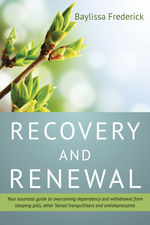
‘Recovery and Renewal’ by Baylissa Frederick

recovery-book-coverRecovery and Renewal is essential reading for anyone trying to withdraw from benzodiazepines and anti-depressants. In fact, it of considerable value to anyone recovering from dependence and addiction.

‘This widely successful book is recommended for anyone in the throes of withdrawal, and for family, friends, professionals and other carers who will be able to better understand the experience and will be well equipped to give support. Doctors, counsellors, rehabilitation staff, recovery and mental health organisations will gain invaluable insight critical to providing best care.

‘Recovery and Renewal’ is regarded as a ‘lifeline’ and readers are inspired by the author’s courage and determination. It gives all the validation needed to eliminate the stress that doubts and uncertainty of what is taking place may bring, and does so with the reassuring feeling of one’s hand gently being held.’

Read More ➔

‘The Importance of Hope in Healing From Depression’ by Douglas Bloch

In this video, author and depression counselor Douglas Bloch talks about how hope can be your best ally when recovering from depression. Please check out Douglas’s website and book on healing from depression, which are top-quality resources.

‘“Do I Have to Feel so Badly About Myself?” – The Legacies of Guilt, Shame and Anxiety’ by Peter Breggin, MD

pbregginGuilt, shame and anxiety are intimately tied to addiction. Here is a blog on these emotions by one of my favourite people, Dr. Peter Breggin, which appeared in Mad in America.

‘Guilt, Shame and Anxiety defines these negative emotions, shows how they act as primitive enforcers of anger management, describes many alternative methods of identifying their presence in our lives, enables us to discover our personal negative emotional profile, and shows how to reject these emotions and to triumph over them.

And now we can answer the question asked in the title, “Do I have to feel so badly about myself?” The answer is a definitive “No!”  You do not have to live with your emotions out of control.  You do not have to feel stymied by painful feelings whenever you seek to be more peaceful or relaxed, more creative, braver, more loving, more independent, or simply happier.  You do not have to live this way.

Read More ➔

I Am Not Anonymous: Lauren’s Story, ‘Will To Bear Discomfort’

LaurenText-1024x682(pp_w1000_h666)I’m starting 2015 with some powerful writing from the I Am Not Anonymous website.

‘When I walked into the door to rehab in early 2008 at the age of 29, I was given a lengthy input questionnaire. I decided it was time to be honest for once.

There was just one question I had to leave blank. I pondered it for the better part of a day and kept returning to it with no decent answer.

What is spirituality? I didn’t have a clue. I reluctantly left it blank. By the time I left rehab almost three months later to return to the life I had left, I had a much better understanding of what spirituality was and how it could help me.

Read More ➔

Merry Xmas… and some words of Native American wisdom

IMG_0142I’m going to take some time off, so this is my last blog until the New Year. I’d therefore like to take this opportunity to wish you all a happy and relaxing Christmas break and all the best for 2015.

I hope you’ve found this website of some value. If you haven’t already done so, you might like to visit my other website, Sharing Culture, which is a part of an initiative focused on Indigenous healing I have developed with filmmaker Michael Liu.

I’d like to end this year with some pearls of wisdom written by Don Coyhis on the basis of what he was told be a Native American Elder in New Mexico:

Read More ➔

‘High Price: Thinking about Drugs with a Social Conscience’ by Carl Hart

I often read about psychoactive drugs being ‘evil’. However, drugs themselves don’t have the capacity to be evil. They are a powder, not a person.

Moreover, the psychoactive effects of drugs are not fixed. As I have described in an article on this website, drug effects are not just dependent on the chemical substance itself, but also on the person and the setting in which the drug is taken.

Drugs are often used by people to cope with psychological pain in their life. For example, many people who become addicted to the pain killer heroin have been abused in their lives. Many people drink alcohol excessively to help them deal with problems in their life. Sadly, society focuses on the symptoms (e.g. drug use) rather than the underlying problem (e.g. trauma).

Read More ➔

Classic Blog: ‘Family Stories, Secrets and Survival’ by Dr. Judith Landau

This talk will provide you with insights into intergenerational trauma and how addiction arises as a coping response. It will show you a way forward to recovery and healing, through Story. Understanding the past can help us deal with the present and help create a better future.

Judith, thank you for this wonderful talk! Here is the Youtube intro:

‘Dr. Judith Landau tells the story of trauma and recovery through generations and gives clues along the way for healthier families.

Read More ➔

‘Healing is in Our Stories’ by Deron Drumm RIP

ddrummHere’s an excellent article by the late Deron Drumm about the importance of Stories in helping people recover and change the mental health system which appeared on Mad in America.

‘”It’s important that we share our experiences with other people. Your story will heal you and your story will heal somebody else. When you tell your story, you free yourself and give other people permission to acknowledge their own story.” Iyanla Vanzant

I have spent a lot of time talking to politicians, media members and those working in the mental health system about the failings of the current method of viewing and treating emotional distress. I have come to the conversations armed with stats and outcomes about the bio-medical paradigm. I have found that the people I speak with do not doubt the facts conveyed. They seem to agree that the current state of affairs is not good. The difference is that I think the tragic outcomes demonstrate the failure of the current system. The folks I talk to tend to think things are so bad because “mental illness is just that serious.”

Read More ➔

‘A Horrifying Journey Through the Medical System’ by Elizabeth Kenny

Actor and playwright Elizabeth Kenny performs an excerpt from her play dramatizing her horrifying journey through the American medical system. This is a story of iatrogenic injury caused by SSRIs and other medications.

If you want to learn more about such problems, then please check out the brilliant Beyond Meds blog by Monica Cassani.

‘Finding Human Life on Earth’ by Carina Håkansson

chakanssonHere is an excellent blog from the Mad in America website. Carina Håkansson is a psychotherapist and manager at Family Care Foundation in Gothenburg, Sweden, which was founded in 1987.

It’s a funny old world because I spent three years in Gothenburg from 1981 in the early stages of my neuroscience career, conducting postdoctoral research with Arvid Carlsson, the father of dopamine research. Dopamine is the brain neurotransmitter classically associated with schizophrenia.

As some of you know, I left my neuroscience career behind me in 2000 because I did not believe that drug treatments were helping people recover from addiction and mental health problems. Anyway, here is Carina:

‘Through the ISPS listserve, I read a blog this morning written by Thomas Insel, director of the NIMH. The way he described people I daily meet in work and in my own life created a rising pulse, so I decided to find  out some more about his thoughts and practice. I am not saying that what I read on his blog is unknown to me, but still it made me wonder how on earth is it possible to invest so much money – and resources – in research which is so distant from practice, and so far away from humanistic and holistic ideas and theories.

Read More ➔

Drug Companies: Stop Drugging Our Kids For Acting Like Kids!

It’s a funny old world! We put people in prison for selling amphetamine and cocaine , but allow drug companies to ‘deal’ ritalin to our children… 4.5 million children in the USA. Ritalin, like amphetamine and cocaine, is a Schedule II drug and has similar neurochemical effects in that it enhances dopamine function. This hypocrisy – and the damage it is doing to our children – disgusts me.

Fortunately, we have people like Michael Corrigan and Peter Breggin fighting against this unsavoury practise. Here are two wonderful animations from Michael Corrigan.

Read More ➔

‘Prison-Based Recovery Advocacy (The San Quentin Story)’ by Bill White

San Quentin ARC Group Counseling Image‘The stage is set for a recovery-focused advocacy and peer support movement within the U.S. prison system.

The mass incarceration of drug offenders in recent decades, the growth of prison-based addiction treatment, the growth and diversification of prison-based recovery mutual aid, increased disillusionment with incarceration as a policy strategy of addiction containment, and the rise of grassroots recovery community organizations in local U.S. communities have all been part of this incubation process.

There is a growing critical mass of people in correctional institutions who are initiating and sustaining addiction recovery and who are pursuing service to others as part of their recovery processes.  Leaders are rising to articulate ideas and launch programs that address the particular needs and aspirations of people seeking recovery within the shadow of the criminal justice system.

Read More ➔

‘Losing a Self: Lying to Yourself’ by Stephanie Brown

rsz_41a-shrpktl_bo2204203200_pisitb-sticker-arrow-clicktopright35-76_sx342_sy445_cr00342445_sh20_ou02_I’ve made reference to Stephanie Brown’s brilliant book A Place Called Self: Women, Sobriety, and Radical Transformation in past blogs. I’ve recommended this book to several women in early recovery and they have really like it. Here, Stephanie describes how one’s self (or identity) changes in a negative manner during the process of addiction. She focuses on lying to oneself.

‘… addiction develops over time, and it involves changes in the way you behave but also changes in the way you think: the way you think about drinking, the way you think about yourself, and the way you think about life.

You start to build your sense of self on a a false belief, the belief that you can control your drinking or other addictive behavior. This isn’t an easy thing to do. Since you really don’t have control, you’re going to have to lie to yourself in order to believe you are not addicted. You have to tell yourself more and more elaborate lies over time, as evidence to the contrary becomes more and more compelling, and you have to rationalize or explain it away. All your energy goes into pretending….

Read More ➔

‘A Different Kind of Evidence’ by Bill White

Addiction Journals Credit Wiley Asia BlogMore wisdom from Bill White.

‘Some years ago, a noted research scientist was invited to speak at a local community forum on the subject of addiction. The presentation to more than one hundred interested citizens consisted of a sweeping overview of modern scientific studies on addiction and its clinical treatment.

In the question and answer session that followed the presentation, a member of the audience posed a question about the effectiveness of recovery mutual aid groups like AA, NA, Women for Sobriety, and SMART Recovery.

The speaker responded that there had been few randomized trials comparing the differences in long-term recovery outcomes between these individuals who had achieved recovery with and without mutual aid participation.  The scientist declared that no definitive scientific evidence yet existed on the effectiveness of such groups.

Read More ➔

Classic Blog: ‘How Forgiveness Can Change Your Life’ by Peter Breggin

Unknown-1-1I have a high regard for the work of the psychiatrist Peter Breggin. Here is an article he wrote on forgiveness for the Huffington Post earlier in the year. Forgiveness plays a key role in recovery.

‘Early in 1865, in his second inaugural address, little more than a month before his assassination, Abraham Lincoln stood before the bloodied, fractured United States to speak about forgiveness, the letting go of hatreds, and the binding of wounds. He implored the people of America:

“With malice toward none, with charity for all, with firmness in the right as God gives us to see the right, let us strive on to finish the work we are in, to bind up the nation’s wounds, to care for him who shall have borne the battle and for his widow and his orphan, to do all which may achieve and cherish a just and lasting peace among ourselves and with all nations.”

Read More ➔

Gabor Maté: When The Body Says No – Mind/Body Unity and the Stress-Disease Connection

‘Stress is ubiquitous these days – it plays a role in the workplace, in the home, and virtually everywhere that people interact. It can take a heavy toll unless it is recognized and managed effectively and insightfully.

Western medicine, in theory and practice, tends to treat mind and body as separate entities. This separation, which has always gone against ancient human wisdom, has now been demonstrated by modern science to be not only artificial, but false. The brain and body systems that process emotions are intimately connected with the hormonal apparatus, the nervous system, and in particular the immune system.

Emotional stress, especially of the hidden kind that people are not aware of, undermines immunity, disrupts the body’s physiological milieu and can prepare the ground for disease. There is strong evidence to suggest that in nearly all chronic conditions, from cancer, ALS, or multiple sclerosis to autoimmune conditions like rheumatoid arthritis, inflammatory bowel disease or Alzheimer’s, hidden stress is a major predisposing factor.

Read More ➔

Behind the Pages with Bessel Van Der Kolk, MD

“The vast majority of drug abuse is associated with earlier trauma. It’s very rare to see somebody who becomes a drug addict who not also has a history of abuse and neglect.” Bessel Van Der Kolk, MD

Behind The Pages host Diane Goshgarian interviews author Bessel Van Der Kolk, MD about his new book The Body Keeps The Score: Brain, Mind, and Body in the Healing of Trauma. Interview recorded at 22-CityView Cambridge on October 08, 2014.

As I said last week, this book is essential reading if you are working in the mental health and addiction fields.

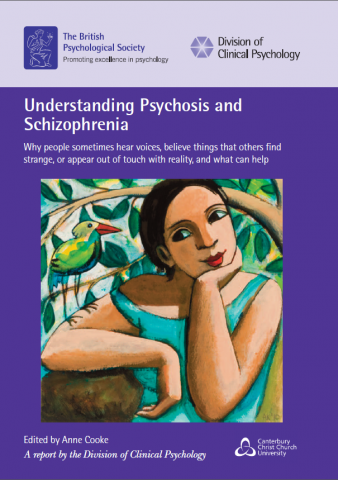
Understanding Psychosis and Schizophrenia

understanding“An individual having unusual difficulties in coping with his environment struggles and kicks up the dust, as it were. I have used the figure of a fish caught on a hook: his gyrations must look peculiar to other fish that don’t understand the circumstances; but his splashes are not his affliction, they are his effort to get rid of his affliction and as every fisherman knows these efforts may succeed.” Karl Menninger

What would happen if a team of highly qualified psychologists joined up with a team of people who knew psychosis from the inside, from their own journey into madness and then recovery – and if they collaborated in writing a guide to understanding the difficult states that get names like “psychosis” and schizophrenia”?

Well, you don’t have to wonder anymore, because the result was published a couple of days ago in the form of a report (180 pages) that is free to download. This report is well worth reading. Here’s a summary:

‘Executive Summary
This report describes a psychological approach to experiences that are commonly thought of as psychosis, or sometimes schizophrenia. It complements parallel reports on the experiences commonly thought of as bipolar disorder and depression.

Read More ➔