Climbing Out of Addiction and Depression: Margo Talbot at TEDxCanmore

Great talk and pics and one hell of a recovery! I first posted this film in July 2014.

‘Current research suggests that addiction and depression are symptoms of emotional distress, not causes of it, forging the link between childhood trauma and mental illness. Margo Talbot’s journey supports these studies.

Diagnosed Bi Polar at age twenty-two, Margo spent the next fifteen years in suicidal depression before discovering the healing power of presence as the antidote to emotional trauma. Being present to our thoughts and emotions, not running the other way or masking them. Where best to practice the art of presence than the frozen world of ice climbing…
Read More ➔

‘Shh… Just Whisper it, But There Might Just Be a Revolution Underway’ by Peter Kinderman

I have just received two books written by Peter Kinderman from a publisher as part of a thank-you for reviewing a book proposal. The books look real good, so I thought I’d start this new part of the Resources with an excellent article by Prof Peter Kinderman which was posted on Mad in America in August 2014. I first posted Peter’s article on Recovery Stories at the same time.

‘The idea that our more distressing emotions can best be understood as symptoms of physical illnesses is a pervasive, seductive but harmful myth. It means that our present approach to helping vulnerable people in acute emotional distress is severely hampered by old-fashioned, inhumane and fundamentally unscientific ideas about the nature and origins of mental health problems.

We need wholesale and radical change in how we understand mental health problems and in how we design and commission mental health services.

Read More ➔

Eleanor Longden: The Voices in my Head

Brilliant and very moving TED talk from Eleanor Longden.

‘To all appearances, Eleanor Longden was just like every other student, heading to college full of promise and without a care in the world. That was until the voices in her head started talking. Initially innocuous, these internal narrators became increasingly antagonistic and dictatorial, turning her life into a living nightmare.

Diagnosed with schizophrenia, hospitalized, drugged, Longden was discarded by a system that didn’t know how to help her.

Longden tells the moving tale of her years-long journey back to mental health, and makes the case that it was through learning to listen to her voices that she was able to survive.’ TED2013

‘Say ‘No’ to the Fiction of Brain Diseases: Towards a New Psychiatry’ by Robert Berezin, MD

UnknownSome of you will know that I was a neuroscientist for 25 years. I left the field because I did not feel that the idea of so-called ‘brain diseases’ and drug treatments were doing much to help people recover from addiction and mental health problems.

The more I read, the more I feel that parts of psychiatry – not all – has a lot to answer for. Here’s an excellent blog from the Mad in America website, by Robert Berezin from Harvard Universty.

‘During my lifetime I have witnessed the fall of Freudian psychiatry and the ascension of molecular psychiatry. Unfortunately, we have gone from the frying pan into the fire. I certainly do not subscribe to old-fashioned psychoanalytic ideas which had been beset by considerable problems throughout the years. Its practice suffered from dogmatic theories and miscast beliefs, which worked to the detriment of responsiveness to our patients.

Read More ➔

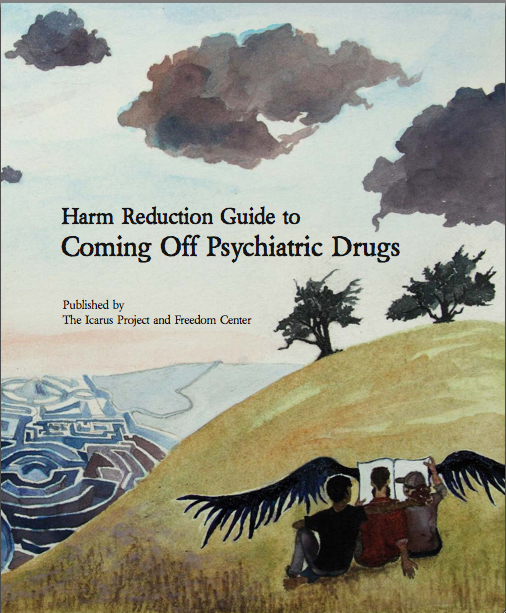
Harm Reduction Guide to Coming Off Psychiatric Drugs and Withdrawal

ComingOffDrugsGuideCOVERBIGThe second edition of the excellent Harm Reduction Guide to Coming Off Psychiatric Drugs and Withdrawal is now available for free download or purchase.

‘The Icarus Project and Freedom Center’s 52-page illustrated guide gathers the best information we’ve come across and the most valuable lessons we’ve learned about reducing and coming off psychiatric medication.

Based in more than 10 years work in the peer support movement, this Guide is used internationally by individuals, families, professionals, and organizations, and is available a growing number of translations.

Includes info on mood stabilizers, anti-psychotics, anti-depressants, anti-anxiety drugs, risks, benefits, wellness tools, psychiatric drug withdrawal, information for people staying on their medications, detailed Resource section, and much more.

Read More ➔

Relationships, Connection and Healing from Trauma

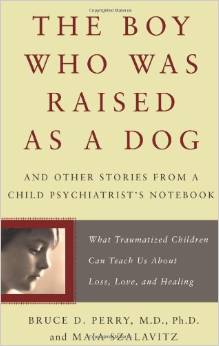
UnknownI’m reading an excellent book at the moment, which I can strongly recommend to you. If you’re working in the trauma field, then The Boy Who Was Raised as a Dog: And other Stories From a Child Psychiatrists Notebook by Bruce Perry and Maia Szalavitz is an essential read.

The book really gives you a feel for how our understanding of childhood trauma and its healing has moved along over the years. Bruce Perry is a real leader in this field and I feel blessed to have learnt of both Bruce’s and Bessel van der Kolk’s work in the past year. Thank you Judy and Carlie Atkinson.

Here’s a little section from the book:

‘Trauma and our responses to it cannot be understood outside the context of human relationships… The most traumatic aspects of all disasters involve the shattering of human connections. And this is especially true for children…’

‘Because humans are inescapably social beings, the worst catastrophes that can befall us inevitably involve relational loss.

Read More ➔

Breaking Trauma Trails: Facilitating the Healing of Indigenous People (Part 4)

3702998I recently wrote three blogs about my other initiative Sharing Culture – which is focused on the healing of Indigenous people – and what we are trying to do [Part 1, Part 2 and Part 3]. It is time to continue with another part, which will focus on our activities over the past 18 months.

Progress To Date
The first development was the Sharing Culture website, launched in late-2013. We set out with the aim of developing a small website focusing on historical trauma, healing and culture, primarily using the voices of Indigenous people (which is why you see so many quotes) within an organised framework. We wanted our audience to gain a basic understanding of key issues relating to Indigenous healing.

The information (written and film) I provided was obtained from web pages, books, science papers and personal communications. A considerable amount of research, reading and watching of films was involved in bringing this content together. In addition to this content, I included Stories, both of individuals (e.g. Professor Judy Atkinson) and initiatives (e.g. the Native American Wellbriety Movement).

Read More ➔

Phil Valentine Sets Off Today: Recovery on the Appalachian Trail

photo-224x300“First of all, celebrations to Phil on his five year recovery from cancer (Today!). And for over 27 years in recovery from addiction.

And if that is not enough he will – in 6 – 8 months time – be in recovery from walking the Appalachian Trail. But firstly, he’s got to walk – and today, get started!!

Wishing you the very best from down under, Phil. We’ll be following you, thinking of you, and spiritually walking alongside you. Enjoy yourself, good friend. Go, Phil, Go.” David Clark and Michael Scott

And for those of you who do not know what is going on, you can find out more here and here. We’ll be following Phil from time-to-time on his journey and I strongly encourage you to follow him directly via: https://twitter.com/pvalentine59 and https://instagram.com/pvalentine59/

Read More ➔

Recovery Walks the Appalachian Trail: From Phil’s Family

photo-224x300Yes, Phil Valentine begins his amazing journey this week. I hope his family doesn’t mind, but I just had to show two beautiful blogs that wife Sandy and daughter Samantha have written for Phil’s travel website.

10 Days by Sandy Valentine (March 7, 2015)
‘It’s only 10 days until Phil hops on a plane to Georgia, and officially begins his adventure. Each day this week, he adds another item to the table of supplies he started. Each time I wonder what item will be the first to go when he’s worn that pack a few hours.

I also wonder – who will I blame when the tp roll isn’t changed? Who is going to clear the driveway a la the winter that never ends? Who is going to remind me “trust them (kids) til they give us a reason not to”? Who’s going to make the family brunch on Sundays?

No one can replace his presence in the house, but as we’ve done before, we will create a new “normal”.

Read More ➔

Breaking Trauma Trails: Facilitating the Healing of Indigenous People (Parts 2 and 3)

42115582. Working towards solutions with Sharing Culture
We developed Sharing Culture as a way to help tackle historical trauma (and its consequences) and facilitate Indigenous healing.

Sharing Culture is a grassroots initiative based on the core values of authenticity, connection, courage, creativity, empathy and forgiveness. We use a strengths-based, solution-focused approach that celebrates success and fosters positivity, acceptance and cultural pride.

We recognise that self-determinism is a central foundation of healing – solutions must come from Indigenous communities. At the same time, non-Indigenous people can contribute to this healing process in a variety of ways.

One major way that Sharing Culture will facilitate this healing process is to generate high quality educational content and Stories about Indigenous healing and the healing of trauma, and distribute it in the most effective manner to as wide an audience as possible.

Read More ➔

Classic Blog: ‘Learning Leadership: How to become a leader in the NHS’ by Professor Aidan Halligan

I’m watching again the excellent BBC TV series from the 1990s, Cardiac Arrest, and it reminded me of this film clip. Time to put it up again.

‘Aidan Halligan, Professor of Foetal and Maternal Medicine and Director of Education at UCL reflects on his experiences of being a leader in the NHS. He shares the stories of people he respects as leaders, and analyses the key features that make them so effective.

Leadership is “… going into the unknown with courage. People respect courage and they respect compassion.”

“We know when we see a leader. They inspire us and when we’re inspired we become determined. And when we are determined we go further. That’s what leadership is about… And it’s your example that counts, not your rank. And if you care about patients to the point of being selfless, people will always respect that.”

Read More ➔

Breaking Trauma Trails: Facilitating the Healing of Indigenous People (Part 1)

3702998“Indigenous people possess a gift. This is a gift of healing, strong relationships and a deep connection to land, from a culture that has flourished over many thousands of years.” David Clark and Michael Liu

1. Nature of the Problems
As a result of the historical experiences of colonisation (and associated violence and control), forcible removal of children, and loss of culture and land, Indigenous people of Australia (and other countries) have suffered a trauma that has been passed unwittingly down through the generations.

The consequences of this historical, or intergenerational, trauma include poor physical health, mental health problems, drug and alcohol addiction, domestic violence and abuse, self-harm and suicide.

Today, the impact of historical trauma is exacerbated by economic and social disadvantage, experiences of racism and paternalism, and ongoing grief resulting from multiple bereavements. It is exacerbated by closing down of remote Indigenous communities, destruction of Indigenous sacred sites, and turning over of Indigenous land to the mining industry.  

Read More ➔

‘5 Reasons Why I Could Get to Katahdin’ by Phil Valentine

springer_mtn_ga_at-225x300I couldn’t resist putting up this Hooked on Recovery blog from Phil Valentine. [If you missed out on my blog yesterday about Phil’s amazing trip, please check it out.]

“What, then, shall we say in response to these things? If God is for us, who can be against us?” Romans 8:31

I’ll be on Springer Mountain, Georgia in just a few days (03.19.15) to start my Appalachian Trail (AT) adventure. I set up a card table in my man cave and have started to get all my gear in one place. I bought a warmer sleeping bag because of all the cold, cold weather in the south this spring. As I talk to people daily about the AT, I’m usually asked…

“How are you feeling, Phil? You must be excited?”

Ya, I’m excited. Partly. And other parts are terrified, nervous, calm, anxious, determined, peaceful, relieved, sad, grateful, happy, curious, … Um, probably others too, but I have never been too good at describing my emotions. I am, after all, a typical male.

Read More ➔

Recovery Walks the Appalachian Trail

Phillip Valentine ’87 (CLAS) on Jan. 15, 2014. (Peter Morenus/UConn Photo)“Phil Valentine’s call to walk the Appalachian Trail is a vivid example of moving beyond recovery FROM life-threatening illnesses as a means of recovering TO a life of extraordinary possibilities. Thousands of us who have shared the challenges and unexpected gifts from such recovery journeys will be walking in spirit with him.” Bill White

A great Recovery Story starts soon, on 19th March 2015. Well, the Story is already happening, but a new phase starts on that date. Phil Valentine, Executive Director of Connecticut Community for Addiction Recovery (CCAR) begins his amazing walk of the Appalachian Trail.

Phil is already a great example of what one can achieve in recovery. But now he takes his journey to another level. We’ll be following Phil from time-to-time on his journey and I strongly encourage you to follow him directly via: https://twitter.com/pvalentine59 and https://instagram.com/pvalentine59/.

Read More ➔

‘Towards a Ban on Psychiatrically Diagnosing and Drugging Children’ by Peter Breggin, MD

Here’s the latest blog (and films) on Mad in America from one of my favourite people. I am so pleased that Peter has done these films. I believe strongly that the mass drugging of our children is absolutely disgraceful.

Instead of hope and enthusiasm for their futures, too many children now grow up believing they are inherently defective, and controlled by bad genes and biochemical imbalances.  They are shackled by the idea that they have ADHD and then subdued by the drugs that inevitably go along with the diagnosis.  Unless something intervenes, many of them will go on to pass their days on Earth in a drug-impaired, demoralized state.

Read More ➔

Understanding Indigenous Wellbeing

TristanSchultzArtwork“Indigenous people have a holistic view of health and wellbeing that incorporates the physical, spiritual, mental, emotional, scial and environmental. It does not just focus on the individual, but also on the health and wellbeing of the community.”

Indigenous Heath and Wellbeing
To appreciate the many ways that society can facilitate the healing of Indigenous people, we must understand the Indigenous view of health and wellbeing. It is different to that of western culture.

Indigenous people have a holistic view of health and wellbeing that incorporates the physical, spiritual, mental, emotional, social and environmental. It does not just focus on the individual, but also on the health and wellbeing of the community.

This view, which has been in existence for tens of thousands of years, is far richer than the western concept of mental health, which comes from an illness or clinical perspective.

Read More ➔

‘From Trauma to Transformative Recovery’ by Bill White

Trauma to Transformation Image‘Between 1986 and 2003, I served as the evaluator of an innovative approach to the treatment of addicted women with histories of neglect or abuse of their children. Project SAFE eventually expanded from four pilot sites to more than 20 Illinois communities using a model that integrated addiction treatment, child welfare, mental health, and domestic violence services.  This project garnered considerable professional and public attention, including being profiled within Bill Moyers’ PBS documentary, Moyers on Addiction:  Close to Home.

My subsequent writings on recovery management and recovery-oriented systems of care were profoundly influenced by the more than 15 years I spent interviewing the women served by Project SAFE and the Project SAFE outreach workers, therapists, parenting trainers, and child protection case workers.  This blog offers a few reflections on what was learned within this project about the role of trauma in addiction and addiction recovery.

Read More ➔

Classic blog: ‘Talking About Psychosis, Part 1: Why Do It?’ by Marc Ragins MD

mraginsThe stuff on Mad in America just keeps getting better and better. Here’s a thought-provoking blog from another of my favourite bloggers.

‘I was taught in medical school and psychiatric residency not to talk to people about their voices and their delusions:  “It will only feed into them and make them worse.”  Nor was I supposed to argue with people with paranoia because they’ll just get agitated and won’t change their mind anyway.

We were taught that the psychoanalysts had wasted a lot of time trying to connect people with psychosis by trying to find meaning in their psychosis.  I was taught that there is no meaning.  All we needed to know about their psychosis was enough to prescribe medications and assess if the meds worked.

The venerable Chestnut Lodge where Frieda Fromm-Reichmann had treated the woman in “I Never Promised You a Rose Garden” with psychoanalysis was successfully sued for not providing research-proven meds instead of talking with patients with psychosis.

Beyond that, I was told not to try to relate to the patients in the State hospital because they couldn’t handle relationships and when I left they’d feel abandoned and decompensate.  Most of my medical school class mates were more than happy to follow that advice and left the ward as fast as possible. They already knew that “people with psychosis are creepy and frightening and frustrating anyhow” without having met any of them.

Read More ➔

‘Healing Trauma: What We Are Doing Wrong… and What We Need To Do To Get It Right’ by Bessel van der Kolk

338059More from Bessel van der Kolk’s wonderful book. If you want to know more about trauma and its healing, this is an essential buy.

‘We are fundamentally social creatures – our brains are wired to foster working and playing together.

Trauma devastates the social-engagement system and interferes with cooperation, nurturing, and the ability to function as a productive member of the clan.

In this book, we have seen how many mental health problems, from drug addiction to self-injurious behavior, start off as attempts to cope with emotions that become unbearable because of a lack of adequate human contact and support.

Yet institutions that deal with traumatized children and adults are all too often bypass the emotional-engagement system that is the foundation of who we are and instead focus narrowly on correcting “faulty thinking” and on suppressing unpleasant emotions and troublesome behaviors.

Read More ➔

‘Cultural Genocide Survivor Walking The Red Road’ by Wayne William Snellgrove

a07bb170c4a36161aa1f8f4859c19794_LI can’t begin to appreciate what it must have been like to have been removed from my mother at a very young age and be brought up in a culture I knew was not my own. This happened to so many Indigenous people in Australia, Canada, USA, New Zealand and other colonized nations.

When I read stories like the one below,  I know I am doing the right thing with my life, trying to help Indigenous people through Sharing Culture. I marvel at the healing that is illustrated in stories like the one below. I know that we must pass on such stories, so many other people can be inspired to Walking the Red Road. That they can take their own journey of healing.

Here is the story of Wayne William Snellgrove, which appeared on the I Love Ancestry website.  

Read More ➔