‘My Story: How I Was Healed From Depression’ by Douglas Bloch

It was great to recently hear from Douglas Bloch who asked if I might include his Story as posted on his website. Great idea, Douglas!

‘In his book, Prayer is Good Medicine, physician and researcher Larry Dossey maintains that praying for oneself or others can make a scientifically measurable difference in recovering from illness or trauma. It is one thing to understand such a healing intellectually; it is another to know it from experience.

Such an experience came to me in the fall of 1996 when a painful divorce, a bad case of writer’s block, and an adverse reaction to an antidepressant medication plummeted me into a major depressive episode.

Read More ➔

Breaking Trauma Trails: Facilitating the Healing of Indigenous People

4323131_origSince moving to Australia, I’ve become increasingly saddened, concerned and angered by the way that Aboriginal and Torres Strait Islanders are treated by many non-Indigenous people (including government). As a friend said the other day, it has to be seen to be believed.

The damage that has been done to Indigenous people here (and in other countries) as a result of colonisation is huge and it continues today. It is a great demonstration of the resilience of Indigenous people that they have survived.

I’ve decided to devote most of my time from now on to working with Indigenous people. I’ll be running this website and working on recovery-related projects.

Read More ➔

‘Back in the Dark House Again: The Recurrent Nature of Clinical Depression’ by Douglas Bloch

dblochOne my favourite bloggers is in a dark place at the moment. He’s had the courage to write about it on Mad In America and what he has to say will help other people. My thoughts are with Doug, a truly caring and inspirational person.

“There is not one of us in whom a devil does not dwell.
At some time, at some point, that devil masters each of us.
It is not having been in the dark house,
but having left it, that counts.” Teddy Roosevelt

Eighteen years ago, in the fall of 1996, I plunged into a major depression that almost killed me. On the evening of my admittance to a psychiatric hospital I saw the above quote from a documentary on Teddy Roosevelt. For the next ten months, it informed my experience, as I did everything I could to leave the dark house I was in.

Eventually, I was healed without medication and wrote about my experience in my memoir, When Going Through Hell…Don’t Stop: A Survivor’s Guide to Overcoming Anxiety and Clinical Depression.

Read More ➔

‘Stigma Reduction Through Recovery Contact’ by Bill White, Tom Hill and Greg Williams

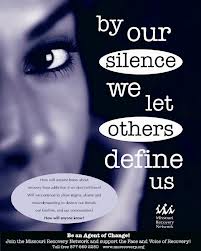
Silence PosterMore insightful writing from Bill White and colleagues.

‘Debates continue on whether the stigma attached to persons experiencing alcohol and other drug (AOD)-related problems has a positive or negative social effect on the nature and magnitude of these problems.  Stigma promoters argue that public castigation of excessive AOD users prevents such use at a cultural level and exerts pressure for AOD deceleration/cessation among those with AOD problems.

Stigma detractors argue that such castigation inhibits help-seeking, forces excessive AOD users into subterranean drug cultures, promotes their sequestration through mass incarceration, poses barriers for the reentry of people seeking recovery into mainstream society, and places undue blame on individuals and groups while ignoring the ecology of addiction – the environmental conditions in which alcohol and other drug problems flourish.   

Read More ➔

‘A Life Rebuilt’ from Dawn Farm

Spotted this on DJMac’s Recovery Review. As DJ says: ‘Here’s a beautifully shot, authentic short film which captures how hope powers recovery.’

‘Amy came to Dawn Farm’s Spera Recovery Center feeling “broken and hopeless and like [she] didn’t have a soul”. In detox, she found others who felt the same way, but also found hope and faith.

Slowly, she learned to face her fears with faith that, if she does the next right thing, things will work out. Two years sober, this faith allows her to confront her fears as her biggest supporter faced cancer.

Read More ➔

‘A Tuesday With Bob’ by Deron Drumm

ddrummI cannot emphasise enough how important grassroots activism is for creating change in the mental health and addiction fields. A clear example of a successful movement is Mad In America, started by Robert Whitaker after publishing his book of the same name.

Here’s a thoughtful and passionate blog which illustrates just how much this movement means to people on the ground.

‘Robert Whitaker’s books and website have changed my life in profound ways. Nearly two years ago, thanks to the generosity of Dorothy Dundas, I was able to have dinner with Bob and several activists.

I sat next to Bob for two hours and was only able to summon the courage to say the deeply philosophical words, “I liked your book.” It was a long ride home to Connecticut that night with that phrase repeating in my head and the knowledge that I had lost an opportunity to tell someone how they had changed my life.

Read More ➔

“We Shall Remain”

I love this film and song. Says so much and really impacts. It can have a healing influence.

‘WE SHALL REMAIN was created to address the effects of historical trauma in our tribal communities. Many times, these untended wounds are at the core of much of the self-inflicted pain experienced in Native America.

Much like fire, this pain can either be devastatingly destructive or wisely harnessed to become fuel that helps us to rise up and move forward in life with joy, purpose and dignity.’

Indigenous social and emotional wellbeing

imagesIndigenous people have a holistic view of health that incorporates the physical, spiritual, mental, emotional, social and environmental.

It includes healing oneself and relationships with others, such as family and community members. It recognises the importance of connecting to land, culture, spirituality and history, as well as the importance of bonds of reciprocal affection, responsibility and caring.

The Indigenous view of health people also recognises the importance of healing the community, rather than just focusing on the individual.

Indigenous people focus on social and emotional wellbeing, rather than on mental health. They view social and emotional wellbeing problems arising from a broad range of circumstances – unresolved grief and loss, trauma and abuse, domestic violence, removal from family, substance misuse, family breakdown, cultural dislocation, loss of land, racism and discrimination, and social disadvantage.

Read More ➔

‘Recovery Stories – Episode 1: What Does Recovery Mean for You?’ by Cafe TA Center

‘At the 2013 Alternatives conference in Austin, TX, The CAFE TA Center invited people with lived experience to share their thoughts on recovery. Dozens of people chose to participate, and offered their reflections on the recovery process, how the concept of recovery has changed their perspective on mental health, and what public policy makers and the general public need to understand about the concept of recovery.

Read More ➔

‘Listening Across the Stages of Recovery’ by Bill White

Listening‘Addiction shrinks one’s world to a state of stark self-imprisonment.  As the person-drug relationship devours everything else of value, nothing remains that cannot and will not be sacrificed. And as the drug then devours the self, what remains are only manipulative masks interchanged so quickly that any sense of “true self” remains as only a faint memory.  This shell, now masquerading as a person, burns its way through the world leaving human wreckage in its wake – all wounded by addiction’s self-centeredness, dishonesty, disloyalty, depravity, and brutality.

Extreme narcissism, self-will run riot in the language of Alcoholics Anonymous, is the essence of addiction regardless of whether one sees this trait as a cause or consequence of addiction.  It is a paradoxical entrapment manifested in self-absorption (self-inflation and exploitation or self-deflation and serial victimization) and deteriorating capacities for self-care. These styles of self-deception exist within a person fighting to retain and assert his or her fading humanity.  These are the Janus faces of addiction – the Dr. Jekyll and Mr. Hyde of addiction fame.

Read More ➔

Western Massachusetts Recovery Learning Community: Hope & Healing Through Community

‘This 12 minute video about the Western Massachusetts Recovery Learning Community (RLC) introduces viewers to the RLC philosophy and provides a window into that community in all its diversity and vibrancy!

The Western Mass RLC supports individuals who have lived experience with trauma, extreme emotional states and/or mental health diagnoses in finding their own paths to recovery by offering trauma-sensitive peer supports and through the development of a regional peer network.

Read More ➔

‘Why Don’t They Know? A Letter to My Doctor’ by Lisa D.

lisadWestern societies today are drugging large numbers of people into illness. And I don’t mean street drugs you get from dealers.

I mean the prescription drugs you get from your doctor, the ones promoted and pushed by drug companies. The ones you think are going to help you overcome your problems. Instead, many people find they cause them problems, problems they take years overcoming.

If you want to know more about this, then you must visit Mad In America. I’ve been using some of the stories and articles on this website on Recovery Stories. And they make fascinating – and concerning – reading.

Here’s a letter that Lisa D. wrote to her doctor about her prescription-drug induced problems (please note that I have shortened the length of some of the paragraphs, without altering the content).

Read More ➔

‘We Are All Connected: Reflection on Robin Williams’ Suicide’ by Pat Deegan

CW, CBS And Showtime 2013 Summer TCA Party - ArrivalsLike so many, I was deeply affected by Robin Williams’ suicide.  I was a big fan of his comedy.  In one of his greatest moments of standup, he invented a new psychiatric medicine he called “Fukitol” and forever won my heart. I also loved most of his dramatic performances such as Good Morning Vietnam, The Birdcage, and Good Will Hunting.

I knew all along that Robin Williams was one of us.  He reveled in outrageous genius that always teetered on madness.  He made the world laugh, while he wrestled with depression and battled his addictive demons.

Of course, he slipped at times.  He took wrong turns and made some bad choices.  But he was resilient.  He kept self-righting. He sought out help including detox, medications, therapy and mutual support groups.

Read More ➔

‘Dr Mark and The Village’ by Mark Ragins

Unknown-3Here is an article by one of my favourite people in the mental health field, Mark Ragins on Mad in America. Mark is the Medical Director at the MHA Village Integrated Service Agency, a model of recovery based mental health care.  His practice has been grounded in 20 years+ with some of the most underserved and difficult to engage people in our community.

‘My name is Mark Ragins.  Most people at The Village call me Dr. Mark, except those who have known me long enough to forego that pedestal and just call me Mark.  I’m a psychiatrist, a story teller, and the kid who used to drive his parents and teachers crazy asking “Why?” unendingly and then, never satisfied with their answers, looked for my own answers and returned to tell them that their answers were wrong.

When I meet someone new I usually try not to tell them I’m a psychiatrist too soon.  There are so many strange and scary ideas about psychiatrists and mental illnesses out there that I’m afraid I’ll be rejected before I even have a chance.

Read More ➔

Eleanor Longden: The voices in my head

Brilliant and very moving TED talk from Eleanor Longden.

‘To all appearances, Eleanor Longden was just like every other student, heading to college full of promise and without a care in the world. That was until the voices in her head started talking. Initially innocuous, these internal narrators became increasingly antagonistic and dictatorial, turning her life into a living nightmare.

Diagnosed with schizophrenia, hospitalized, drugged, Longden was discarded by a system that didn’t know how to help her.

Longden tells the moving tale of her years-long journey back to mental health, and makes the case that it was through learning to listen to her voices that she was able to survive.’

Russell Brand: my life without drugs

26th Annual ARIA Awards 2012 - Award Winner PortraitsA great article in the Guardian by Russell Brand. He’s doing some great work.

Russell Brand has not used drugs for 10 years. He has a job, a house, a cat, good friends. But temptation is never far away. He wants to help other addicts, but first he wants us to feel compassion for those affected.

The last time I thought about taking heroin was yesterday. I had received “an inconvenient truth” from a beautiful woman. It wasn’t about climate change – I’m not that ecologically switched on – she told me she was pregnant and it wasn’t mine.

I had to take immediate action. I put Morrissey on in my car as an external conduit for the surging melancholy, and as I wound my way through the neurotic Hollywood hills, the narrow lanes and tight bends were a material echo of the synaptic tangle where my thoughts stalled and jammed.

Read More ➔

Ivan Oransky: Are we over-medicalized?

‘Reuters health editor Ivan Oransky warns that we’re suffering from an epidemic of preposterous preconditions — pre-diabetes, pre-cancer, and many more. In this engaging talk from TEDMED he shows how health care can find a solution… by taking an important lesson from baseball.’

Elyn Saks: A tale of mental illness — from the inside

“Is it okay if I totally trash your office?” It’s a question Elyn Saks once asked her doctor, and it wasn’t a joke.

A legal scholar, in 2007 Saks came forward with her own story of schizophrenia, controlled by drugs and therapy but ever-present. In this powerful talk, she asks us to see people with mental illness clearly, honestly and compassionately.

‘Stigma and Service Integration’ by Bill White

Stigma and Service Integration ImageIn his latest blog, Bill White emphasises the importance of Recovery Stories and their value in tackling stigma.

‘One of the emerging trends of U.S. health care reform is the tri-directional integration of addiction treatment, mental health services, and primary health care.  This is evident in the growing integration of addiction and psychiatric treatment under the rubric of “behavioral health care,” efforts to integrate primary health care within addiction treatment settings, and increased delivery of addiction-related services within primary health care settings, e.g., physician offices, health clinics, and hospitals.

Considerable resources have been invested in creating policy frameworks for such integration (e.g., provisions for office-based treatment of opioid dependence) and developing technological innovations (e.g., screening, assessment, and treatment protocol) to facilitate such integration, but history would suggest a far greater obstacle to service integration:  social and professional stigma.

Read More ➔

‘How Can We Spread the News?’ by Kjetil Mellingen

kjmelliGreat article from Mad in America with excellent discussion.

‘Ever since I read Mad in America and later Anatomy of an Epidemic by Robert Whitaker, I have been wondering how to spread this knowledge to the masses and how to do this in a way that will make a difference to as many people as possible.

I used to teach creativity and brainstorming to corporations, and I would like to use the brain force of the MIA readers to find out new ways of influencing as many as possible with our message. In creativity research it has been shown that it is important to not be critical of your ideas in the early stages. Anything you can think of may be valuable, even if it seems crazy in the beginning. Often  the craziest ideas can bring the best results.

These ideas are called stepping stones. Just write them down, share them, and often you or others will see a practical modification of the idea that may actually be used.

Read More ➔