 After visiting Ian and Irene MacDonald, I headed back to my usual base when I am visiting the UK, the Beech House Hotel in Reading. It’s a wonderful family-run hotel that I have been staying in for over a decade whilst I visit my three youngest children. The next morning, I delivered my hire car back to the main office, and then headed to Heathrow airport to catch a flight to Edinburgh.
I was soon on my way to my favourite UK city where I would be meeting some of my favourite people, the staff and patients at Lothians and Edinburgh Abstinence Programme (LEAP), led by my close friend Dr David McCartney. I first visited LEAP in 2007, at a time when my eldest daughter Annalie was a medical student at the university. For some years, even after I moved to Australia, I would spend the day talking with staff and patients. My discussions with David and his Clinical Lead Eddy Conroy were enjoyable, thought-provoking, and inspiring.
 One of the most powerful pieces of writing I have come across about a person’s relationship with alcohol was written by Beth Burgess, a UK Recovery Coach from
  In a previous blog post in this series, I described how Claire Brown of Drink and Drugs News (DDN) commissioned me to write articles for the magazine that she and Ian Ralph had launched. Here is an article I wrote on WIRED (later called Wired In) that was published in that very
  In my last blog post, I described how I met Ian and Irene MacDonald at their home on the outskirts of Cheltenham during my last trip to the UK in September 2022.
 After leaving Wulf and Melanie Livingstone’s house in North Wales, I headed to Ian and Irene MacDonald’s home in the outskirts of Cheltenham. I first met Ian Macdonald at the FDAP (Federation of Drug & Alcohol Professionals) Annual conference in 2007; we had previously corresponded about a few articles that I posted on our news portal Daily Dose. We hit it off immediately. Ian told me how he and Irene had he had lost their 27-year-old son Robin to an accidental heroin overdose in November 1997.
 In my last blog post,
  There have been various definitions of addiction recovery proposed over the years. For the purpose of this blog post, I am going to use a definition proposed by leading addiction recovery advocate William (Bill) L White [1]:
 In July 2011, I gave an invited talk, Transforming Health Care Systems to be Recovery-Focused, at the Fresh Start Recovery Seminar in Perth. A good friend of mine, Adam Brookes, who was in recovery from addiction, gave a five-minute speech to open the day’s event. Adam’s speech is one of my endearing memories from the time I have spent working in the addiction recovery field. Here is that speech:
 I came across this wonderful blog post by Jim LaPierre back in 2011 and wrote about it on Wired In To Recovery. It’s well worth a read. On his Linked In page, Jim describes himself as ‘a seasoned mental health therapist and substance abuse counselor. I am the clinical director of Higher Ground Services in Brewer, Maine.’
 I’ve just been reading through a chapter I have written for a book I am working on, tentatively called Those Who Came Before: A Personal Journey Into Understanding Drug Addiction and Addiction Recovery. In the chapter, I describe how I started writing for the magazine Drink and Drugs News in late 2004. I wrote a series called Background Briefings for nigh on four years. Here’s how it all started:
 Here is a very important blog post that I
  In my last blog post, I described my 2022 reunion with Natalie, a recovering heroin addict who first inspired me to start writing recovery stories back in the early 2000s. You can read the version of Natalie’s Recovery Story, I Didn’t Plan To Be An Addict, I initially wrote for this website back in 2013
  It was wonderful for me to catch up with ‘Natalie’ whilst I was in Wales in September 2022. She was the first treatment service user I spent in-depth time with, and from whom I learnt a good deal about the nature of heroin addiction and recovery. She told me that when she was using heroin, she did not know how to stop. She could find no information about how to stop using. She knew no one who had stopped using. The solution to these problems was to keep using, letting heroin kill her pain, shame and the hatred of herself for what she had become.
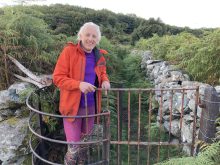 On Friday 23 September, I left Gower and headed to Tregarth in North Wales, via Aberystwyth and Dolgellau (where one of my ancestors was born), to stay with Wulf Livingston and his lovely wife Melanie. As I had such a tight schedule, I was due to stay there only one day, but my cousin Emma (my next visit) had just tested positive for Covid, so I ended up staying two days with Wulf and Mel.
 I have recently uploaded
  Here’s an excellent article by the late Deron Drumm about the importance of Stories in helping people recover and change the mental health system which
  Then why not check out my eBook Our Recovery Stories: Journeys from Drug and Alcohol Addiction, which is available via
  As the end of 2022 is approaching, I thought I’d provide the titles of, and links to, the 38 posts on my Recovery Stories blog from this year. The photograph alongside is of Rowdy Yates, who we lost in February this year. Rowdy was a true addiction recovery champion. In the photograph below, taken in Stirling on 25 March 2009 by Mark Gilman, I am with Rowdy. Here are the first 20 of my blog posts this year, the earliest in the year shown first:
 Whilst on Gower, I caught up with my old best schoolmate in Melton Mowbray, Jeff Zorko, along with this wife Marian and daughter Rosie. Jeff and I spent a number of years working in jobs in different places around the world, only to find we both ended up living on Gower. They have known my three youngest children since each of them were born. Jeff became an invaluable Trustee on our charity Wired International Ltd, which funded Wired In activities. I am very grateful for the charity work he did then and the long-lasting friendship I have had with him and his family.