
Many of Marion’s study participants were thriving, living a successful life and doing far more than just surviving.
Strategies to Face Adversity: Learning
August 31, 2013 by
Many study participants expressed that learning about their culture was an important part of survival as an Aboriginal person in today’s Aboriginal society.
Strategies to Face Adversity: Humour
August 30, 2013 by
Humour for most participants was an important coping mechanism used to deal with the many adversities they had to face on a daily basis. It was also used to help deal with stressful and painful traumatic events suffered by some participants.
What facilitates recovery from mental health problems?
August 30, 2013 by
 I was looking through my old blogs on Wired In To Recovery and came across this one.
The blog is based on a paper by Wendy Brown and Niki Kandirikirira, entitled “Recovering Mental Health in Scotland: Report on Narrative Investigation of Mental Health Recovery”. It’s the 19th manuscript in the list on this page.
‘This research involved the recovery narratives of 64 individuals in Scotland who identified themselves as being in recovery or recovered from a long-term mental health problems.
Strategies to Face Adversity: Letting Go, Forgiveness and Healing
August 29, 2013 by
Every participant spoke of the healing process and how before such a process can begin, they had to let go of negative emotions such as anger and hatred.
Changing Education Paradigms: Animate from Sir Ken Robinson
August 29, 2013 by
Although you might think this film is not strictly related to addiction recovery, I assure you that it is. Education plays a key role in recovery, as does the way we are taught to think.
I love this talk, as well as the use of the animate. Sir Ken is a leader in the education field and you can find a number of videos of his talks on YouTube. I agree with him wholeheartedly that we need to change the way we educate young people (and old!)
And there are some interesting facts about the prescribing of drugs in the treatment of ADHD.
Strategies to Face Adversity: Role Models
August 28, 2013 by
Role models were important to many participants and played a major role in many individuals being able to face and overcome the many adversities they had to face during their lives.
Strategies to Face Adversity: Health
August 27, 2013 by
Although health was not a major concern for most participants, some saw health as an important factor underlying resilience.
‘The Work of Recovery’ by Bill White
August 27, 2013 by
 I missed this very important recent posting on Bill White’s website which is well worth reading.
‘Research on addiction recovery is quite scant compared to the volumes of research on addiction-related pathologies and clinical interventions. Additionally, some of the most important research on addiction recovery is buried in academic journals, rarely if ever read by the people who need it most – addiction treatment professionals and people needing, seeking or in recovery. Such is the case of studies on the role of work in addiction recovery.
In 2011, Dieter Henkel of the Institute for Addiction Research at the University of Applied Sciences in Frankfurt, Germany, conducted a comprehensive review of international studies on the relationship between substance use and employment that was published in Current Drug Abuse Reviews (4, 4-27). Henkel drew the following conclusions from his review of more than 130 scientific studies:
Daring Greatly: How the Courage to Be Vulnerable Transforms the Way We Live, Love, Parent, and Lead
August 26, 2013 by
 Shame plays a major role in keeping people locked in addiction. Shame of what a person has become through their addiction, and how it has affected relationships with loved ones and friends, can drive people to more self-medication in efforts to alleviate the feelings experienced.
In the section Books to facilitate your recovery, I have recommended Brene Brown’s latest book Daring Greatly, which is well worth a read. Brene is a shame researcher who has become a major name in the past few years, in part due to her having the second most viewed TEDx talk. I guess 10.7 million views is what you call viral.
Here’s what I said about Daring Greatly:
“Every now and again, I read a book that I immediately read again (this time using a marker), and then keep picking up to read various bits that I have highlighted. This is the latest of such books.
Strategies to Face Adversity: Education
August 26, 2013 by
Many participants spoke of education as power and how having an education certainly empowered them as individuals.
Recovery Rocks: Chip Somers
August 24, 2013 by
 Really pleased to see the latest Recovery Rocks on the Veronica Valli website. I have a lot of respect for Chip Somers. Here’s what Veronica has to say about her latest interviewee.
‘Chip Somers is the co-founder and CEO of Focus12 Treatment Centre in Bury St Edmunds, UK. Focus12 was the first treatment centre I worked in, and it really did teach me everything I know.
It’s an inspiring place, where no matter what they have done or how low they have gone, addicts and alcoholics are treated with the utmost love and respect. For 16 years they have been putting lives and families back together.
RIOT – Recovery Is Out There
August 23, 2013 by
David McCollom has been making some good films about recovery and recovery-related organisations. Here is one about RIOT, which you can find in our Film Section.
Three people talk about their recovery and introduce RIOT, an award-winning group of recoverees who attended the BAC O’Connor centre. Recovery Is Out There, right!
And you might want to check out RIOT Radio and the short news clip of its opening.
Dealing with Betrayal and Abandonment
August 23, 2013 by
 Beth Burgess flagged this article which appeared on Hubpages. Sometimes things happen in your recovery that are difficult to come to deal with. Here is some excellent advice.
Remain Objective
It is all too easy to blame ourselves when we have been betrayed or abandoned, and to take the actions of others as a personal affront. Most people’s behaviour is a reflection of their own shortcomings or mental state rather than a rejection of you personally.
Try to be objective about the situation – ask yourself if you genuinely did anything wrong, or was this situation brought about because of the other person’s issues. If you do feel that you were somewhat to blame, what can you learn from this occasion and how can you do better in future.
The Addicted Brain: Interview with Marc Lewis
August 21, 2013 by
 Here’s a fascinating interview with Marc Lewis as part of the ABC Radio Big Ideas series here in Australia. Well worth putting your feet up and listening – or have it running in the background.
‘Marc Lewis took every drug imaginable over a 15 year period. He knows drugs can make you feel good, and he experienced the desperate lows of addiction. He’s been drug free for 30 years and is now a neuroscientist.
So what do the drugs he took actually do to your brain? Why do they make you feel the way they do? And – crucially – how is the brain responsible for addiction? He speaks to Paul Barclay.’
‘The Globalization of Addiction’ by Bruce Alexander
August 20, 2013 by
 ‘Global society is drowning in addiction to drug use and a thousand other habits.
This is because people around the world, rich and poor alike, are being torn from the close ties to family, culture, and traditional spirituality that constituted the normal fabric of life in pre-modern times. This kind of global society subjects people to unrelenting pressures towards individualism and competition, dislocating them from social life.
People adapt to this dislocation by concocting the best substitutes that they can for a sustaining social, cultural and spiritual wholeness, and addiction provides this substitute for more and more of us.’
I’ve taken these words from Bruce Alexander’s website and can highly recommend his book, The Globalization of Addiction, which highlights the role of disconnection or dislocation in the development of addiction. This theory makes much more sense than the classical disease model focusing on the role of brain neurotransmitters in addiction.
Cocaine: The experience of using and quitting
August 20, 2013 by
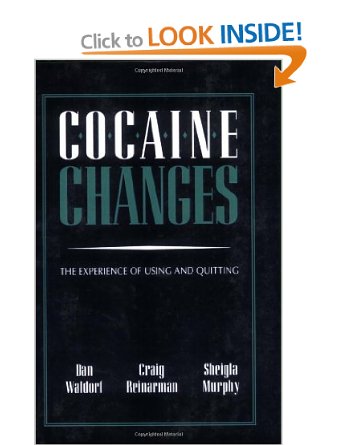 What does scientific research tell us about people overcoming substance use problems? I have previously described the study with US veterans who stopped using heroin after they returned from Vietnam, showing that the common belief that heroin is highly addictive cannot be generalised to all situations.
A variety of other scientific studies have been conducted with people who have recovered from addiction to other substances and we look at another of these studies in this chapter.
Dan Waldorf and colleagues conducted the most comprehensive ethnographic study of heavy cocaine users in the mid-1980s in northern California.
They interviewed 267 current and former heavy users of cocaine, a sample that did not include people in treatment programmes or in prison. Most of the respondents were “solidly working- or middle-class, fairly well-educated, and steadily employed.”
Stress, trauma and addiction: the role of society
August 19, 2013 by
 “Addicts are locked into their addiction not only by their painful past and distressing present but equally by their bleak view of the future as well. They cannot envision the real possibility of sobriety, of a life governed by values rather than by immediate survival needs and by desperation to escape physical and mental suffering.
They are unable to develop compassion to wards themselves and their bodies while they are regarded as outcasts, hunted as enemies, and treated like human refuse.
As we have seen, a major factor in addiction that medical and social policies must take into account is stress. If we want to support people’s potential for healthy transformation, we must cease to impose debilitating stress on their already-burdened existence.
Serenity Recovery Fringe Festival
August 18, 2013 by
 In an earlier blog, I highlighted an article by Bill White on Recovery Carriers.
Recovery Carriers are people, usually in recovery, who make recovery infectious to those around them by their openness about their recovery experiences, their quality of life and character, and the compassion for and service to people still suffering from alcohol and other drug problems.
I know two special Recovery Carriers in Edinburgh – and there are many more – David McCartney and John Arthur. Here’s John’s latest blog:
From Discovery To Recovery: My Emotional Journey As The Parent Of An Addict
August 16, 2013 by
 Powerful writing from Ron Grover, a parent of a son with a substance use problem, which appeared on the Intervene website.
‘What’s it like being the parent of an addict? I’m not talking about the day-to-day experience with a crisis and drama around every corner. I mean what is it like inside the mind of a parent who has gone from discovery (of a child’s drug use) to recovery (from a drug addiction)?
As I take stock of my current emotional state – examining all of the emotions I have felt over the last 10 years – I wonder: Am I normal? Am I a survivor? Am I crazy? Maybe I’m just a composite of these experiences and it’s simply who I am now.
