
‘How Forgiveness Can Change Your Life’ by Peter Breggin

Unknown-1I have a high regard for the work of the psychiatrist Peter Breggin. Here is an article he wrote on forgiveness for the Huffington Post earlier in the year. Forgiveness plays a key role in recovery.

‘Early in 1865, in his second inaugural address, little more than a month before his assassination, Abraham Lincoln stood before the bloodied, fractured United States to speak about forgiveness, the letting go of hatreds, and the binding of wounds. He implored the people of America:

“With malice toward none, with charity for all, with firmness in the right as God gives us to see the right, let us strive on to finish the work we are in, to bind up the nation’s wounds, to care for him who shall have borne the battle and for his widow and his orphan, to do all which may achieve and cherish a just and lasting peace among ourselves and with all nations.”

Read More ➔

‘Helping Populations Progress Through Stages of Change’: Talk by James O. Prochaska

I was thrilled to find this video on YouTube, a talk by one of the psychology greats, James Prochaska.

‘A scientific revolution is occurring in the field of behavior change. This revolution involves a shift from an action paradigm to a stage paradigm in which changing troubled behavior involves progressing through six stages of change: precontemplation, contemplation, preparation, action, maintenance and termination.

Previously almost all research and treatment programs were action-oriented but less than 20% of people with such behaviors are prepared to take action. Action-oriented programs resulted in relatively low participation rates, high dropout rates and small impacts on populations with unhealthy behaviors.

Read More ➔

Recovery as an organising construct – Bill White interviews Larry Davidson

UnknownI have just been reading a Bill White interview of Larry Davidson – the two people who have most impacted on my work – and I was very interested by Larry’s response to these two questions about the mental health field. What is said is of course highly relevant to the addiction field.

Bill White: How is the emergence of recovery as a new organizing paradigm changing the design and delivery of mental health services in the United States?

Larry Davidson: I think the biggest change that the recovery paradigm has introduced, and the change that poses the most difficulty for traditional clinicians to understand and accept, is that recovery is primarily the responsibility of the person rather than the practitioner.

Read More ➔

Recovery Vision: New paradigm, new questions, new answers

I’ve just watched this wonderful talk (from 2001) by Bill Anthony, one of the pioneers in recovery-based care in mental health. [Bill starts his talk at 25’20” into the video]

Bill describes a metaphor for explaining a paradigm shift, such as the paradigm shift to recovery-based care in mental health.

This metaphor is that mankind once thought the world was flat. This understanding led to certain questions such as, “How far do I sail before I fall off the end of the earth?” Once mankind learnt the world was round, these questions were redundant. We asked different questions.

Read More ➔

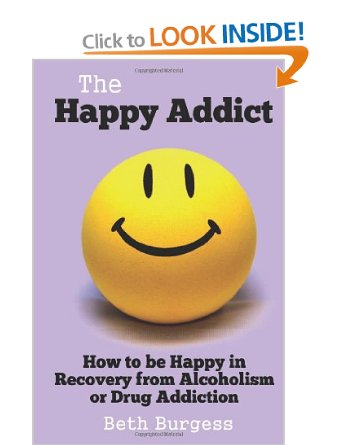
Book Review: ‘The Happy Addict: How to be Happy in Recovery from Alcohol or Drug Addiction’ by Beth Burgess

41+RPl0IiaL._BO2,204,203,200_PIsitb-sticker-arrow-click,TopRight,35,-76_SX342_SY445_CR,0,0,342,445_SH20_OU02_We’ve heard quite a bit from Beth Burgess on this website. The reason for this is quite simple. Beth is always busy. Last week, I included her column from the Huffington Post, this week a review of her latest book from the website Drug Addiction Treatment.

‘It sounds like an oxymoron, The Happy Addict. How can an addict be happy, right? Leave it to a clever marketer to come up with a catchy title like this, one that literally draws the reader in. That is, if the reader has an interest in learning how it is humanly possible to be “happy” in recovery from alcoholism or drug addiction.

But, wait, that’s the rest of the title of this no-nonsense, witty and well-written book by Beth Burgess: The Happy Addict: How to Be Happy in Recovery from Alcoholism or Drug Addiction.

Read More ➔

Support for You – One Woman’s Story

Louise C. runs a successful family business in Scotland that employs 90 people.

But she very nearly lost all of this, and her life, due to chronic alcoholism. Louise thanks her family for getting her into treatment. She remembers the day her family dropped her off at Castle Craig: “It took three men to drop me at the door of Castle Craig.”

She admits that “the best thing to do with alcoholics is to gang up on them and give them no option but to try treatment and face up to their addiction.” Once that is done, “you’re half-way there.”

Read More ➔

Are you a Victim of ‘Compare and Despair’? by Beth Burgess

london recovery coach.jpgHere’s the latest article from Beth Burgess in the Huffington Post:

‘Much of our unhappiness comes from comparing ourselves to where we think we should be, or where others are, rather than seeing what is positive about our own reality. Instead of trying to keep up with the Joneses, we should be focusing on ourselves and ploughing our unique furrow.

As an addiction therapist, one of the things I regularly hear from clients who are newly sober is that they feel like they are behind everyone else when it comes to where they “should be” in life. Having “wasted years”, as they see it, stuck in a negative lifestyle, they feel like their peers have pulled ahead of them and have their “stuff” all sorted out.

Read More ➔

‘A Personal Story’ by Kerrie

IMG_3429This very moving Story was written for Wired In To Recovery in August 2011.

‘Hi, my name is Kerrie. I am 37 years old. Both my parents died as a result of heroin addiction. My mum when I was 8 years old and she was 28, and my dad when I was 15 and he was 43.

I grew up in the madness of their addiction; needless to say we were a very dysfunctional family. I don’t remember my parents ever getting any real support. The only people involved with our family were the police and social services.

Read More ➔

Promoting community led solutions to indigenous youth suicide

I have just received the email below. Last week, I attended an aboriginal healing retreat and had spiritual experiences that confirmed my commitment to helping the Indigenous people of Australia tackle addiction and mental health problems and other consequences of historical trauma.

This email reminds me of the scale of the problem. The video touched my inner soul. I am so happy I have made this commitment. I know the journey ahead is a long one.

Please support this cause, first by sending this blog and the website link out to as many people as possible. Thank you.

Read More ➔

Crack in America

reagan-wife-1Yesterday, I ran a blog written by Bill White showing the questionable ‘science’ that surrounded the so-called issue of crack babies. There was tremendous media hype about crack and crack babies at the time. Why?

I wrote on this issue in the educational series I wrote for Drink and Drugs News nearly a decade ago. Here’s what I wrote in a longer article entitled ‘Regulation and control of drugs: Part 2’.

‘In their book Crack in America, Craig Reinarman and Harry Levine point out the politics that surrounded crack in the US during the 1980s and 90s. Crack first appeared in late 1984 and 1985, primarily in impoverished African-American and Latino inner city neighbourhoods in New York, Los Angeles and Miami.

Read More ➔

‘A Family Illness’ by Phil Hughes

IMG_5024This excellent blog was written three years ago to the day on Wired In To Recovery. 

“I was like a tornado causing as much devastation as I possibly could in my family. But the problem was, I couldn’t even see it because all I cared about was me. I was caught up, obsessed with finding ways and means to get my next drink. When I didn’t have it, I was a nightmare to live with.

My mother felt so helpless, slowly watching her son kill himself through drink and drugs and not knowing whether she was coming or going half the time. It’s through that feeling of helplessness and frustration that the anger started to rear it’s ugly head.

Read More ➔

‘Moral panics, the limits of science & personal responsibility’ by Bill White

Time-Crack kidsAnother classic from Bill White, illustrating how junk science can dominate the sensationalist media and create moral panic, which of course can be used for political gain.

‘From the mid-1980s to the mid-1990s, new patterns of crack cocaine use dominated cultural headlines in sensationalized media frenzies that sociologists refer to as moral panics. Other than cocaine-related violence, no aspect of this alarm garnered greater attention than the images of premature, cocaine-exposed infants trembling within incubators of neonatal intensive care units.  Those infants and children became widely caricatured as “crack babies” and “crack kids” and their images were exploited to forge new laws and policies that in turn fueled dramatic expansions of the U.S. criminal justice and child welfare systems.

Those most dramatically affected by the expansions were poor communities of color who witnessed unprecedented numbers of their young men imprisoned and their young women and children placed under the control of state child protection authorities.

Read More ➔

An educaring approach to healing generational trauma in Aboriginal Australia

Shouting recovery from the rooftopsI was away this weekend in the country at an aboriginal healing retreat, which was an amazing experience. I felt peace in a way that I have not experienced in a very long time. I will blog about this later in the week.

Prior to going on the retreat, I started to look for content on historical trauma, something that I have been thinking more about recently. I have become increasingly aware of the inter-generational trauma which has been experienced by Aboriginal Australian peoples (and indigenous populations of other countries)  and which has resulted in social dysfunction, violence, addiction and mental health problems.

It seems to me that far too few people in Australia are aware of the role of inter-generational trauma in producing the above problems.

Read More ➔

‘Beautiful Boy: More Than An Addict’ by Jim Contopulos

The beauty of the Santa Rosa Ecological Reserve in southern California provides the backdrop for a father’s lament upon losing his beautiful son to addiction and mental illness.

Walk alongside him, as together, we who survive dream of a better day, sustained and inspired by the pain, brokenness and courage of those who live with the unrelenting weight of mental illness and addiction.

Read More ➔

The culture of addiction: Part 2

IMG_2586The second part of this series focuses on the impact of legal status on drug culture. Click here for part one.

Society makes judgements about different types of psychoactive drug. As Bill White points out in his book Pathways from the Culture of Addiction to the Culture of Recovery, the social status and value attached to a particular drug by society influence several things:

  • The risks associated with use of the drug
  • The organisation of ‘tribes’ within the culture of addiction
  • The characteristics of each tribe and the impairments that members experience from both the drug and the culture itself.

 Clearly, there are likely to be differences in a variety of factors for drugs that are legal (e.g. alcohol) and those that are prohibited by law (e.g. heroin).

Read More ➔

The culture of addiction: Part 1

384985_10150365241281765_1866835833_nThis is the first of two blogs on the culture of addiction. I will later look at the culture of recovery, and after that consider how we can help people move from the culture of addiction to the culture of recovery.

These articles are based on the seminal writings of William L White, in particular from his book Pathways from the Culture of Addiction to the Culture of Recovery. In this book, Bill provides key insights into how we can help people move cultures – essential in their journey along the path to recovery.

‘Culture’ generally refers to patterns of human activity and the symbolic structures that give such activities significance and importance. Wikipedia

Read More ➔

‘Sober is Sexy’ by Beth Burgess

Ah yes, all the cool kids are sober these days. Don’t worry that being sober is boring – it isn’t. It’s a blast! “I’ll tell you what’s really cool. Not caring what other people think. Doing the right thing. Doing something that’s a little different to everyone else. That’s what cool. That’s what’s sexy.” Check out many more videos on Beth’s YouTube page.

‘A Day With Dave’ by Annalie Clark

My lovely daughter Annalie heads back to the UK tomorrow, having spent a year here in Perth working as a doctor (along with her boyfriend Max) in the emergency department of  a local hospital. I will miss them both greatly, but I’ve had such a special year with them.

Here’s an article that Annalie wrote in the summer of 2005, when she had just finished her first year of medical training at the University of Edinburgh. It appeared in a June edition of Drink and Drugs News. The article is about Dave Watkins who used to be a top-class support worker at a treatment centre in Swansea.

What is striking about this article is that Dave’s role resembles what I envisage a recovery support worker (or recovery coach) would be doing today. Annalie highlights Dave’s extensive contacts within, and knowledge of, the local community, which helps the lives of the people with whom he works. In the video above, you can see one of the magic tricks that Dave used to engage the people he was working with.

Read More ➔

‘What’s Next for the Truth?’ by Suzanne Beachy

Any diagnosis of mental illness results in a complicated and uncertain fate for those it strikes. When you lose a son as a result of such a diagnosis, it ignites a search for answers. Suzanne Beachy has gained a perspective on life as a result of her loss but is still asking, “What is the truth?”

Suzanne gave this talk at the TEDxColumbus event in 2010.

“Creating Connections through Dialogue” conference

‘We live in an increasingly interdependent and interconnected world. The Creating Connections conference was an opportunity to explore various aspects of connectedness and the implications for recovery.

Health and mental health providers, people with the lived experience of mental health challenges and recovery, family members and others were invited to participate in workshops and joined in facilitated dialogue sessions to connect and learn from one another to become more effective in our lives and in our work.’

Read More ➔